
Green Series
The Life of Sir Stanley Maude
Major-General Sir Charles Edward Callwell’s 1920 life of Sir Stanley Maude, the general who rebuilt the army in Mesopotamia after Kut and entered Baghdad in March 1917.
Available now
Explore the edition →
Life and work
1859–1928
Major-General Sir Charles Edward Callwell · KCB
The theorist of small wars who sat at the centre of a great one.
Charles Callwell made his name not in the field but in the files. From the Intelligence Branch he read his way through a century of colonial campaigns and in 1896 published Small Wars, the British Army’s handbook of expeditionary war.
Return to the editions ↓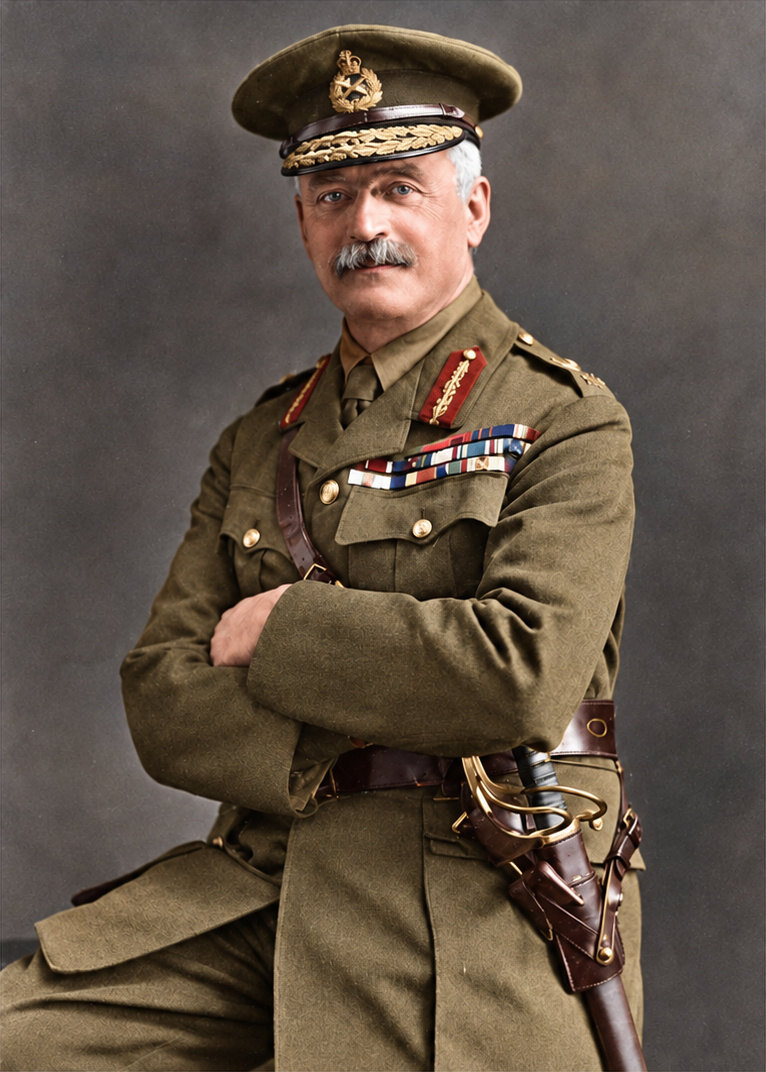
The Life of Sir Stanley Maude follows Maude from the Coldstream Guards to Baghdad, written by the officer who had directed military operations at the War Office.
Green Series
Major-General Sir Charles Edward Callwell’s 1920 life of Sir Stanley Maude, the general who rebuilt the army in Mesopotamia after Kut and entered Baghdad in March 1917.
Available now
Explore the edition →Life and work
Born in London in 1859, Callwell went from Haileybury and Woolwich into the Royal Artillery in 1878. He served in the Second Afghan War and in Natal, and from 1887 to 1892 worked in the Intelligence Branch of the War Office. Small Wars set out how a regular force fights an enemy who will not stand in line: by supply, by movement, by seizing what the adversary cannot afford to lose.
He left the Army as a colonel in 1909. The war of 1914 recalled him as Director of Military Operations and Intelligence, with the temporary rank of major-general. For eighteen months the demands of France, the Dardanelles, Salonika and Mesopotamia met at his desk. After the war he wrote quickly and from the inside, among other books a life of Sir Stanley Maude, the general who took Baghdad.
Official style in the 1918 notice; no earlier award date inferred.
Second Class of the Serbian order, notified in the London Gazette in 1918.
The Royal Artillery took him to India and into the Second Afghan War of 1880; in 1881 he was in Natal at the close of the first war with the Transvaal Boers. The Intelligence Branch then gave him the comparative material from which his theory grew, from the Cape frontier to the Indian borderlands.
Small Wars was revised in 1899 and 1906; Military Operations and Maritime Preponderance followed in 1905, an inquiry into what command of the sea gives and denies to an army ashore. He served through the South African War and retired in 1909 without a general’s rank.
In August 1914 he returned to the War Office as Director of Military Operations and Intelligence. There he weighed the claims of several theatres against the means of a single army, and in 1916 he travelled to Russia on a mission concerned with munitions.
After 1918 he wrote The Dardanelles, the sardonic Experiences of a Dug-Out, The Life of Sir Stanley Maude, Stray Recollections and, in 1927, the life and diaries of Field-Marshal Sir Henry Wilson, whose candour caused a public storm. The Maude biography rests on the general’s diaries and letters and on the written estimates of officers who served with him; its admiration is open, and so is its criticism.
Callwell remains a revealing military thinker because he treated difference as an operational problem. His work also records the coercive ends to which that professional intelligence was directed. As a biographer he wrote with the knowledge of the War Office side of the campaigns he described.
Participant narrative and comparative theory offer different views of British campaigning in Africa; no personal influence is asserted.