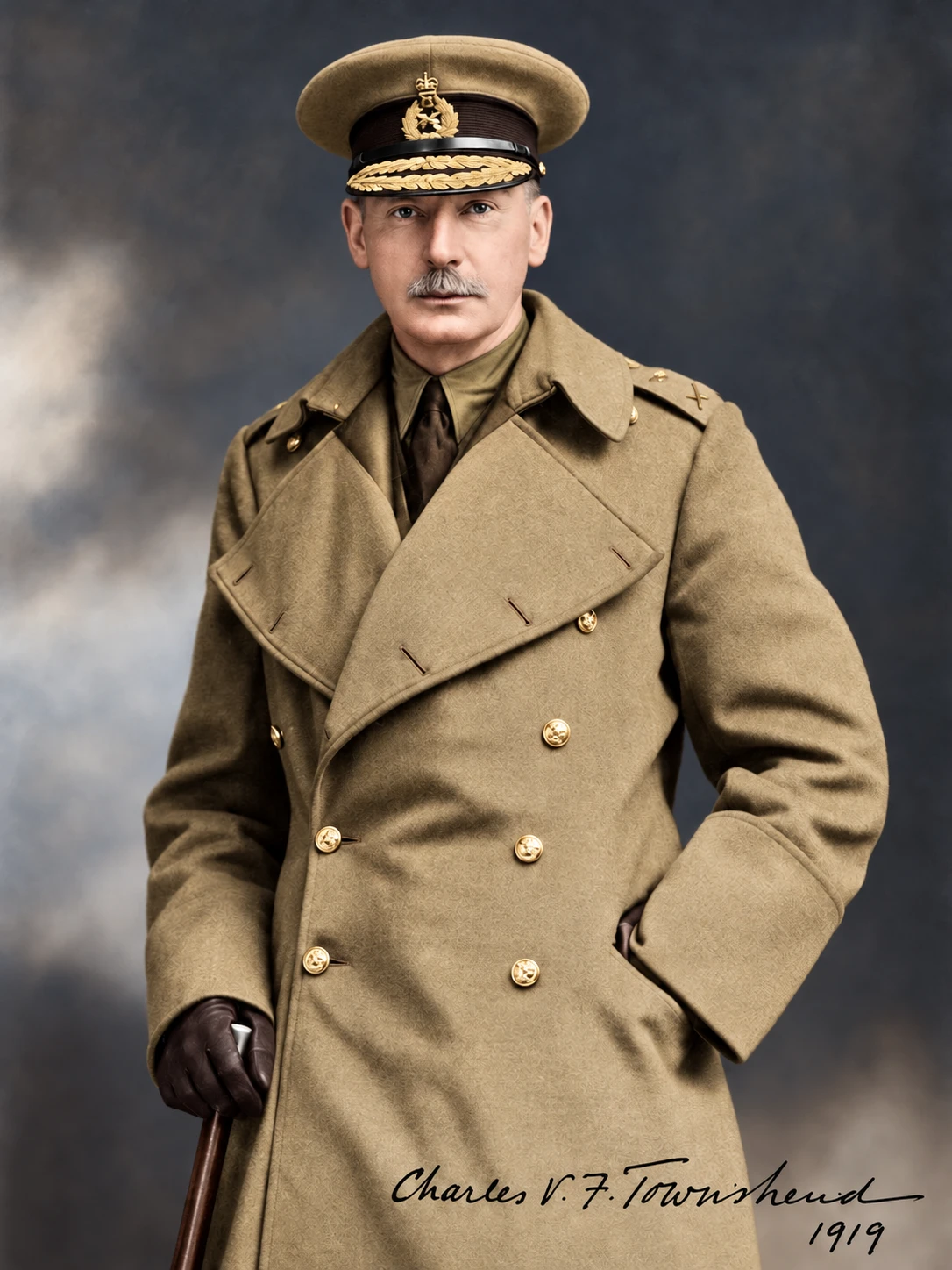
Major-General Sir Charles Vere Ferrers Townshend · KCB (1917), DSO (1898)
From the frontier fort at Chitral to the surrender on the Tigris.
After Ctesiphon, Charles Townshend brought his depleted division back down the Tigris and stood at Kut. Twenty years earlier, a relief column had reached the fort he held at Chitral. At Kut, month after month, the force sent to relieve him failed to reach the town. By April 1916, surrender was all that remained to the commander.
The road to Baghdad ran north through heat, marsh, dust and the winding course of the Tigris. Along it advanced the 6th (Poona) Division of the Indian Army under Major-General Sir Charles Townshend: British and Indian regiments moving farther from their bases, farther from reinforcement, and deeper into a campaign in which every mile gained lengthened the line upon which the army depended.
Townshend, the son of a Southwark railway clerk, began in the Royal Marine Light Infantry and made his reputation in Indian service. Chitral brought the CB in 1895. He commanded Sudanese troops in the Egyptian Army, received the DSO in 1898 and rose to major-general in 1911. The 6th (Poona) Division put him at the head of the advance up the Tigris in 1915.
The Mesopotamian expedition had begun around the Persian Gulf, where Britain sought to protect its oil supplies. From Amara and Kut the advance was carried towards Baghdad. After the fighting at Ctesiphon, it ended in retreat and a siege. On 29 April 1916 the British and Indian garrison surrendered. Townshend later published his account of the campaign.
Honours and distinctions
Order · 1895Order of the Bath · Companion (CB)
Military Division. Announced on 16 July for Chitral. The same notice records his separate promotion to brevet major, dated 10 July.
Order · 1898Distinguished Service Order (DSO)
Awarded after the Sudan campaign. Contemporary notices still styled him CB and DSO at the time of the siege of Kut.
Order · 1917Order of the Bath · Knight Commander (KCB)
The King’s College archive catalogue gives 1917 for this higher grade of the Bath.
Decoration · 1895 campaignChitral campaign medal
A contemporary account records a medal with two clasps for the campaign.
Explore the life and work
Origins and early years
From Cranleigh and Sandhurst he went into the Royal Marine Light Infantry in 1881. He transferred to Indian service in 1886. At Gilgit he commanded the Raga Pertab battalion of the Kashmir contingent. His experience on the frontier preceded the six-week defence of Chitral in 1895.
Commands in India, Sudan and Mesopotamia
In the Egyptian Army he commanded the 12th Sudanese Battalion and served in the fighting at the Atbara and Khartoum. Those were years in which British officers could make their careers across several armies of the Empire. Townshend’s wartime command of the 6th (Poona) Division, itself a formation of the Indian Army, belonged to that system.
The Tigris was the route of the advance and the line on which troops and supplies had to reach it. After Ctesiphon, the division went back to Kut. Hunger wore down the garrison while relief attempts failed. Townshend spent his captivity in conditions far removed from the forced marches and privations that killed many of the men he had commanded.
The literary work
My Campaign in Mesopotamia appeared in 1920. Townshend reconstructs what he knew, what he ordered and what he expected his superiors to do. His account stands beside the despatches he wrote during the siege and the letters of fellow prisoners. Read together, they give the decisions at headquarters and the price paid for them their different weight.
Historical places
Chitral
The frontier garrison held for about six weeks in 1895 before relief reached the fort.
Kut al-Amara
The town lies in a bend of the Tigris. The river was the artery of the campaign, and successive attempts to force a passage to the garrison failed.
The legacy
After the war he sat in Parliament for the Wrekin from 1920 to 1922. His account of the expedition remains a source for the predicament of a divisional commander. Its sharpest questions concern the further advance towards Baghdad, the means allotted to it and the decision to stand at Kut.
A life in dates
Commission in the Royal Marine Light Infantry
Transfer to Indian service
Defence of Chitral, appointment as CB and promotion to brevet major
Atbara and Khartoum; Distinguished Service Order
Promoted major-general
6th (Poona) Division advances to Kut and Ctesiphon