Life and work
Elihu Stewart
1844–1935
Northern rivers seen from the deck of a steamer.
A river journey reveals a country in succession: a landing, a settlement, a reach of water, another departure. Stewart follows that changing view through northern Canada, with a forester’s attention to land and resources.
Return to the editions ↓English-language editions
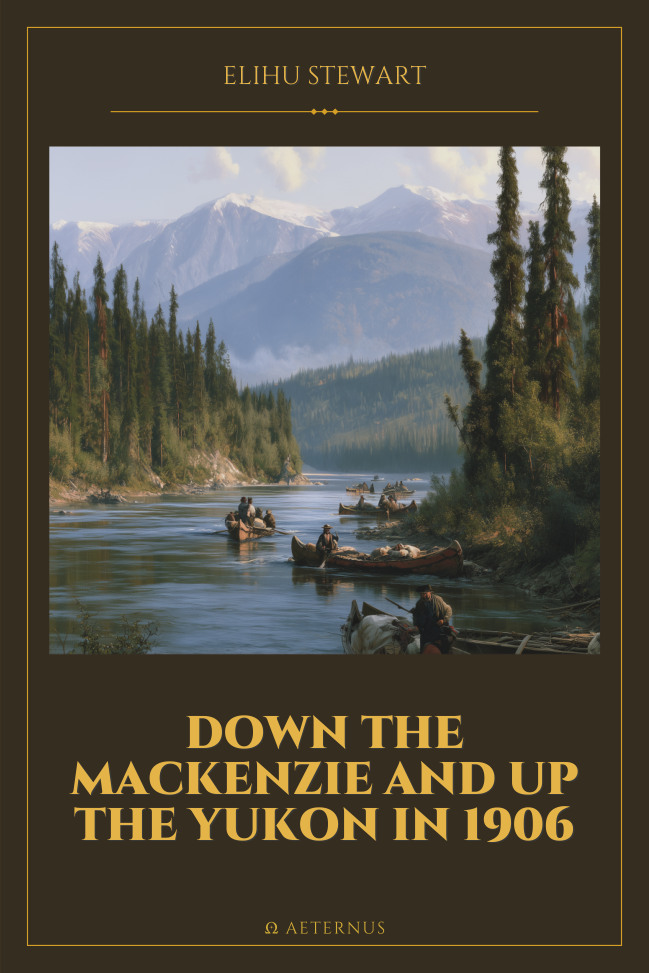
Down the Mackenzie and Up the Yukon in 1906 follows a northern route by its rivers, landings and settlements.
AMBER
In 1906 Elihu Stewart travelled north from Edmonton into a country whose rivers determined the course and pace of a journey. Scows, canoes and steamers carried him through the Athabaska and Mackenzie systems; beyond Fort McPherson he crossed the mountains towards the Porcupine and Yukon, returning through the Klondike country and the Pacific coast.
Available now · Paperback · IngramSpark
Explore the edition →
Life and work
A life in context
Stewart belongs beside the camping writers through his subject rather than a documented membership of their circle. His northern journey adds transport, forestry and settlement to the world of camp and trail.
Explore the life and work
Origins and early years
Elihu Stewart lived from 1844 to 1935. He held Canada’s federal forestry office in the years 1899–1907; his book identifies him as formerly Superintendent of Forestry for Canada.
The course of a life
In the preface to Down the Mackenzie and Up the Yukon in 1906, Stewart explains that the narrative grew from a report submitted to the Canadian government on 16 November 1906. The book allowed room for experiences beyond an official report.
The literary work
The accessible 1913 second edition joins the river narrative to photographs and a map. Stewart notes that many photographs were taken from steamers. The moving viewpoint is part of the book’s character: places emerge along a route rather than as isolated scenes.
Read beside Seton’s The Arctic Prairies, it offers a different northern journey: an account shaped by waterways and a forestry official’s interests. This is a thematic comparison, not evidence of an encounter.
The legacy
The book preserves a way of travelling in which rivers joined distant communities. Reading the route today brings attention back to connections between transport, land and the practical knowledge of a journey.
Historical sources and further reading
Further editions
Ernest Thompson Seton · 1911
Seton’s northern journey connects travel, natural history and the patient observation of animals.
Robert Baden-Powell · 1897
The Matabele campaign narrative connects movement through difficult country with military scouting and field observation.
Robert Baden-Powell · 1899
Baden-Powell’s military scouting manual offers a comparison with the observation and practical judgement of the camp and trail.
Richard Jefferies · 1881
Wood Magic imagines the lives and conflicts of animals within a familiar English landscape.
Ernest Thompson Seton · 1898 · German-language edition
Seton makes the individual animal the centre of a story, extending outdoor observation into narrative.
Ernest Thompson Seton · 1900 · German-language edition
The life of a grizzly gives animal observation the sustained shape of a biography.
Ernest Thompson Seton · 1903 · German-language edition
Boys learning outdoor skills give Woodcraft a narrative form beside the practical camping handbooks.
Ernest Thompson Seton · 1911 · German-language edition
Rolf’s education in the woods brings practical outdoor learning into an adventure story.
Ernest Thompson Seton · 1911 · German-language edition
Seton’s northern journey connects travel, natural history and the patient observation of animals.
Ernest Thompson Seton · 1904 · German-language edition
A California grizzly supplies another meeting point between the animal story and the history of a landscape.
