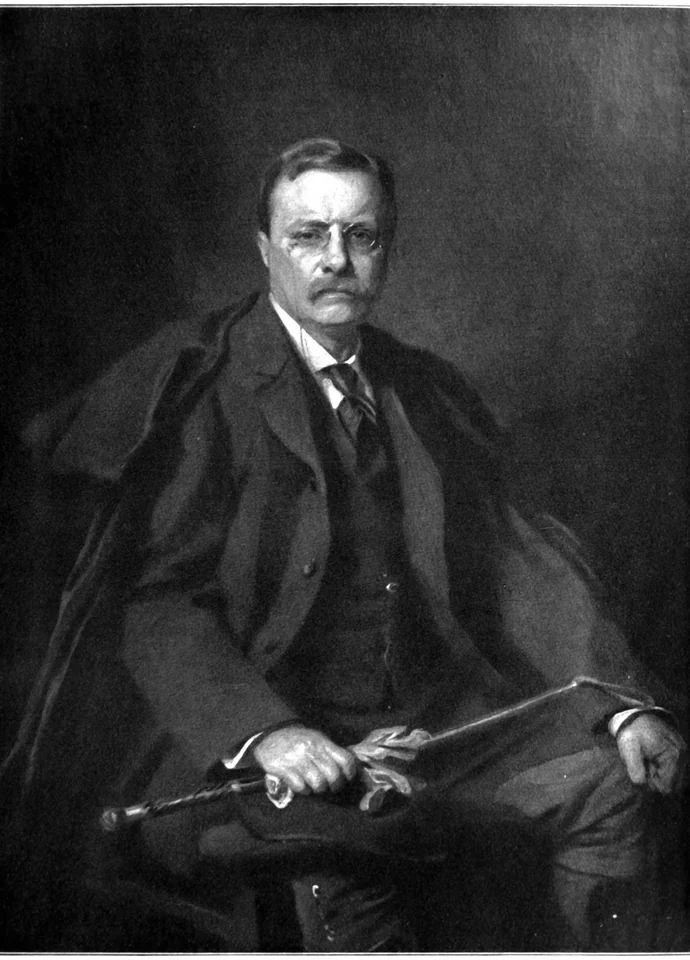
Origins and early years
Roosevelt was the son of Theodore Roosevelt Sr. and Martha Bulloch, of a prosperous New York family of Dutch descent; his mother had grown up in Georgia. He entered Harvard in 1876, graduated in 1880 and began to read law at Columbia that autumn. In the Assembly he made his name as a reformer.
In 1884 illness and the death of his wife sent him west. His mother died on the same day, February 14. He bought into a cattle ranch in the Badlands of Dakota Territory, hunted big game and stayed until 1886, when he returned to New York, married Edith Kermit Carow and went back to politics.
Offices and the war of 1898
President Harrison named him to the Civil Service Commission in 1889, and he remained until 1895. He then took charge of New York City’s police administration. In April 1897 he entered President McKinley’s administration as Assistant Secretary of the Navy and, by the Nobel biographer’s account, prepared actively for the war with Spain that he saw coming.
In May 1898 he was commissioned lieutenant colonel of the First United States Volunteer Cavalry, with Leonard Wood as colonel. The regiment fought at Las Guasimas on June 24 and, on July 1, went up Kettle Hill and on against the San Juan line before Santiago de Cuba. When Wood took the brigade at the end of June Roosevelt took the regiment; he was promoted colonel in July, took the oath on July 31, and mustered out at Montauk Point, New York, on September 15, 1898.
Elected governor in 1898, he took office on January 1, 1899. As President he took the initiative in 1902 that brought the first case before the Hague Court of Arbitration, and in June 1905 offered his good offices to Russia and Japan; the delegates met at Portsmouth, New Hampshire, in August and signed a treaty in September. In 1912 he accepted the Progressive Party’s nomination, and in 1917 President Wilson declined his offer to raise a division. His son Quentin, a fighter pilot, was killed in France on July 14, 1918. Roosevelt died at Sagamore Hill, Oyster Bay, on January 6, 1919.
The literary work
The Nobel biography counts twenty-six books and over a thousand magazine articles. Among them are The Winning of the West, in four volumes (1889–1896), Oliver Cromwell (1900), African Game Trails (1910) and An Autobiography (1913).
The Rough Riders appeared in six parts in Scribner’s Magazine from January to June 1899 and then as a book from Charles Scribner’s Sons. It is the commander’s own testimony: it names troopers and Regulars, counts the dead and wounded, criticizes the supply of the army and credits the Spanish defenders with bravery. Its appendices carry the muster-out roll of the regiment, his report to the Secretary of War and the “Round Robin” letter of August 1898. It was answered in print, and a reader should set it beside the Spanish account of José Müller y Tejeiro.
Historical places
Dakota Badlands
From 1884 to 1886 Roosevelt ranched here, hunted and recovered; the years sit between the Assembly and his return to office.
Kettle Hill and the San Juan line
On July 1, 1898, the regiment went up Kettle Hill and on against the San Juan line. The statute and the citation speak of San Juan Heights; Roosevelt’s book keeps the two apart.
Portsmouth, New Hampshire
Russian and Japanese delegates met here in August 1905, after Roosevelt’s offer of mediation, and concluded a treaty in September.
Sagamore Hill, Oyster Bay
Roosevelt died here on January 6, 1919.
The legacy
The Medal of Honor came by a long road. Roosevelt was recommended in 1898, and the Brevet Board reported in June 1899 without his name. Public Law 105-371 of November 12, 1998, authorized and requested the award for his part in the attack on San Juan Heights on July 1, 1898, and President Clinton presented it posthumously at the White House on January 16, 2001. The Nobel Peace Prize of 1906, presented in his absence, stands beside it as the other distinction.